This rather lengthy essay states what to me at least, is, or should be, obvious. That is wealthier, Democratic countries suffer fewer deaths, injuries, and illness from natural disasters than other countries. They may suffer more economic damage, but only because they have more to lose. The lesson is if we truly care for all people, and truly want to alleviate suffering, the answer lies in improving people's standard of living and promoting Democracy and freedom. Trying to prevent natural disasters, or trying to "stop global warming" or "climate change" is sinfully, and tragically misguided, as I think the following study aptly illustrates.
Peter
DEMOCRACY, GDP AND NATURAL DISASTERS
Geotimes, October 2007
http://www.geotimes.org/oct07/article.html?id=feature_democracy.html
Gregory E. van der Vink and co-authors Amartya Sen won the Nobel Prize in economics in 1998 with the observation that there has never been a famine in a nation that has a democratic form of government and a free press. A similar relationship exists for natural disasters: Deaths associated with natural disasters are lower for nations with democratic forms of government and the associated higher national income, or Gross Domestic Product (GDP).
In general, the World Bank's Democracy Index, a measure of how strong a democracy is, and a nation's GDP are stronger predictors of a natural disaster's humanitarian impact (as measured by deaths) than either the size of the event or the population density in the area of the disaster.
Global increases in democracy and GDP may therefore partially explain the apparent paradox of the generally decreasing death toll associated with natural disasters despite the increased population density in high-risk areas. Natural Disasters Natural disasters result from encounters between natural events and human infrastructure and activity. It is logical, therefore, that the rapid global increase in human population should place more people in the path of natural events, raising both the number of natural disasters and their accompanying death tolls. In addition, climate change, sea-level rise and other environmental phenomena may be increasing both the severity and frequency of events such as floods, hurricanes and other extreme weather that can result in natural disasters.
A historical comparison of annual natural disaster occurrences and disaster-related deaths, however, is inconsistent with the assumed relationship. Despite the increase in natural disasters, reported deaths are actually decreasing - both as a percentage of global population and in total numbers. The average annual percentage of the global population killed by natural disasters decreased 10-fold from the period 1964 to 1968 compared with the period 2000 through 2004, from 0.01 percent (roughly one killed for every 10,000 people) to 0.001 percent (one in 100,000) respectively.
At the same time, the average annual number of recorded disasters increased five-fold between 1964 through 1968 (64 per year) and 2000 through 2004 (332 per year). The events that continue to result in the major number of fatalities are the relatively small percentage of events that occur with large recurrence intervals, such as massive floods, strong earthquakes and direct strikes from intense hurricanes, or events that are unusual in the area in which they occur.
Clearly, the impact of a natural disaster is not simply a function of the natural event itself, but is determined also by society's ability to respond to the disaster. Over the same time period that we observe a decreasing number of disaster deaths, two great global socioeconomic trends of the last half century have also occurred: democratization and economic development.
To evaluate the role that democracy and economic development play in reducing the humanitarian impact of natural disasters, we measured 133 countries' natural disaster death tolls against both their average democracy ranking and their average per capita GDP. We excluded only those nations with a population of fewer than 1 million people, or which have experienced five or fewer disasters between 1964 and 2004.
The Role of Democracy
More than 80 percent of the total global disaster deaths from 1964 to 2004 occurred in just 15 countries, including China, Ethiopia, Sudan, Indonesia and Bangladesh, among others. Of these fifteen nations, 73 percent are below the median global GDP and 87 percent are below the median democracy index. The democracy index is the average of the World Bank's Worldwide Governance Indicator values for voice and accountability, political stability, absence of violence, government effectiveness, regulatory quality, rule of law and control of corruption.
The exceptions to the trend that high GDP correlates with a low death toll after a natural disaster are Iran and Venezuela, both oil-rich countries with significant wealth but low democracy indices. Because the two outliers have high GDP and relatively high death tolls, they suggest that democracy, rather than GDP, may play the more pivotal role in reducing deaths from natural disasters. The strong exponential correlation between democracy and GDP, however, makes it difficult to differentiate the two.
El Salvador also stands out as an outlier. Despite its democratic ranking, the impoverished nation experiences a large number of deaths in the aftermath of a natural disaster. El Salvador does not have a very high democracy rating (-0.1) in general compared to the global median (-0.3). (By contrast, the U.S. democracy index is 1.4, and Finland, which has the world's highest democracy index, is 2.47.) In fact, El Salvador's democracy ranking may be misleading in the context of this analysis. Its democratic constitution was drafted only in 1983, after a long period of political instability and civil war.
Two common characteristics are notable in the countries in which the deadliest disasters have occurred since 1964. First, they all were (and many still are) developing nations: All except one (Peru) had a per capita GDP of less than $1,000 (U.S.) at the time of the disaster. Second, they were (again, many still are) non-democratic states: All except one (India) had a non-representative government or was at war (1965) when the disaster occurred, and India was facing a virtual war against militant Islamists.
Notably, the type of disaster (including earthquakes, storms and floods, for example) varies among the top 10, again implying that the characteristics of the disaster itself count for much less than the characteristics of the nation. The two unifying traits of the nations with the deadliest disasters or, more exactly, the two qualities distinctly lacking in these nations, are democracy and development.
Flooding in Nepal from last summer's monsoons killed hundreds and left millions across Southeast Asia homeless. Regions such as Nepal's Bardiya District in the southwest were particularly hard hit. New research indicates that countries with lower per capita GDP and a lower democracy index are more likely to face a lot of deaths when a disaster strikes than richer countries with stronger democracies.
In contrast, the three costliest disasters occurred in countries that are highly developed and highly democratic - the 1995 Kobe earthquake in Japan, 2005's Hurricane Katrina in the United States and an earthquake in southern Italy in 1980. However, the three costliest disasters resulted in a relatively miniscule number of deaths.
The dichotomy is striking: Natural disasters that occur in undeveloped, non-democratic nations result in a high humanitarian cost but a low economic cost, whereas natural disasters that occur in developed, democratic nations result in a low humanitarian cost but a high economic cost. There is clearly a link between democracy, development and the impact of natural disasters.
The strong exponential correlation between democracy and GDP makes it difficult to resolve the determining factor. In addition, the reason for the strong correlation between the World Bank's Democracy Index and per capita GDP is not fully known. Similarly, it is difficult to determine exactly which of the factors that go into the calculation of the World Bank's Democracy Index have the greatest influence in determining the relationship to the death toll. These considerations are beyond the resolution of our analysis.
What is clear, however, is that the death tolls associated with natural disasters are undeniably linked to level of democratic rule within the nation that the disaster occurs. The relationship between the humanitarian impact of a natural disaster and the democracy of the nation in which the disaster occurs is consistent with the relationship that Amartya Sen discovered between democracy and famine. Deaths from natural disasters are more likely to occur in nations with low levels of democratic rule.
Furthermore, we also calculated the pattern of humanitarian relief aid from both the Office of U.S. Foreign Disaster Assistance (OFDA) - the U.S. Agency for International Development's disaster assistance department - and the U.N. World Food Programme: The analysis indicates that the populations of less democratic nations are more vulnerable to natural disasters. Of the 577 World Food Programme grants awarded between 1987 and 2004, 92.5 percent were given to nations with negative democracy values. Only 12 countries with positive democracy values received aid, and only one (Botswana) had a democracy value greater than 0.5. The majority of both World Food Programme and OFDA aid grants are received by nations with negative democracy scores.
Grant numbers are corrected for the number of countries that fall into each democracy category, so the observed decrease cannot simply be explained by the larger number of less democratic countries. Taken together, data from the OFDA and the World Food Programme further enforce the previous finding that nations with low-levels of democratic rule are more likely to suffer severe humanitarian consequences from natural disasters. The spread of democracy over the last several decades may therefore partially explain why the total number of deaths associated with natural disasters is decreasing despite the increase in the number of events.
Reducing Hazard Vulnerability
Amartya Sen discovered that famines are distinctly non-natural phenomena. Certain climatic conditions, such as droughts, make famines more likely, but they are not the inevitable consequence of environmental circumstances. States and their citizens have the power to prevent, or bring about, as it may be, a famine - and likely other disasters. If famines are almost entirely within the control of governments and citizens, how are we to understand what are collectively referred to as "natural disasters"?
Such events as earthquakes, windstorms (hurricanes, typhoons, cyclones and tornadoes), landslides, volcanic eruptions, floods and droughts are referred to as "natural," implying that they are beyond the sphere of human influence and agency. But are they really? No state or society can prevent the occurrence of an event such as a hurricane or an earthquake. That is beyond the range of human capability. But one can not argue that disasters are wholly independent of human action. After all, a disaster is only a disaster if it affects humans themselves. That is, any natural disaster is the intersection of a natural event and a human population. But if we cannot prevent the event itself, we can certainly influence - reduce or exacerbate, depending on the circumstances - the impact of the immutable event.
Asked in another way, do certain characteristics of any given society or state predispose it to a greater impact or enable it to reduce the impact from natural disasters than states lacking or possessing in smaller or larger amounts those characteristics? And how is one to quantify the impact of a disaster: Should it be measured in terms of lives lost (humanitarian) or money spent (economic) or some combination of the two? Are the incentives for a state to respond in a certain manner moral, societal or financial? If the impact of natural disasters in humanitarian and economic terms is not solely natural, then there exists a clear opportunity for societies and communities at all scales, from familial to global, to influence the impact.
We have to capitalize upon this remarkable opportunity to effect change, ensuring that the influence is a positive one and that more lives are saved and not lost. Vulnerability to natural hazards includes not only the risk of an event - the risk involves both the probability of occurrence and how much infrastructure, both societal and economic, is exposed - but also the resiliency of the infrastructure and the national capacity to respond. Governments with low levels of accountability to their citizens may feel less pressure to maintain a high-level capacity for response to the humanitarian impact of natural disasters. Even if a nation has a comparatively low level of accountability to its own citizens, it may still have a high level of accountability to the global community.
If individual nations become accountable for many of the deaths that occur within their borders in the aftermath of a disaster, a strong international incentive (pressure from the world community) may take the place of accountability through democratic rule. Advances in global communications and economic interdependency may now be making all governments accountable to global citizenry. Deaths from natural disasters can no longer be dismissed as random acts of nature. They are a direct and inevitable consequence of high-risk land use and the failures of governments to adapt or respond to such known risks. If so, then perhaps the most important and possibly least expensive methods for reducing the humanitarian impact of natural hazards is to increase the transparency of risk, improve global awareness of the consequences of high-risk land use and hold accountable governments that place their populace in harm's way without a capacity to respond.
Van der Vink teaches courses on environmental science and natural hazards in the Department of Geosciences at Princeton University in New Jersey. His co-authors are Peter DiFiore, Andy Brett, Edward Burgess, Jacalyn Sproat, Heather van der Hoop, Pamela Walsh, Ali Warren, Logan West, Daphne Tess Cecil-Cockwell, Alain Chicoine, Jevon Harding, Christian Millian, Elena Olivi, Sara Piaskowy and Grace Wright. The authors would like to acknowledge the World Bank and the Office of U.S. Foreign Disaster Assistance for making their data available for this study. They further acknowledge the Department of Geosciences, Princeton University for their support of this project.
© 2007 American Geological Institute. All
Thursday, May 8, 2008

Tuesday, May 6, 2008
The Chaiten Volcano, Chile---A Factor In Climate Change?
If this recent volcanic eruption in Chile causes significant global cooling, we may want all the CO2 in the atmosphere (that allegedly causes warming) that we can get. The links in this article and the linked satellite photo are excellent.

Peter
May 06, 2008
The Chaiten Volcano - Could it Be a Factor?
By Joseph D’Aleo, CCM
The news is reporting a relatively large and long lasting volcanic eruption in Chile. According to the AP, the Chaiten volcano spewed lava and blasted ash more than 12 miles (60,000 feeet) into the sky on Tuesday, prompting a total evacuation of the provincial capital and other settlements. The volcano’s five-day eruption has sent a thick column of ash into the stratosphere, streaming across Patagonia to the Atlantic.
In earlier stories, we noted that there are usually 8 to 12 volcanic eruptions on-going at almost all times. Most are the small guys which emit just lava or if eruptive have their ash and gas clouds only reaching thousands to a few tens of thousands of feet in the air, remaining within the troposphere where the ash and gases quickly falls or gets rained out within a few days or weeks.
It is the bigger eruptions that reach above this tropospheric layer into the more stable stratosphere that can have long lasting (up to several years) and extent effects (global).
It is the bigger eruptions that reach above this tropospheric layer into the more stable stratosphere that can have long lasting (up to several years) and extent effects (global).
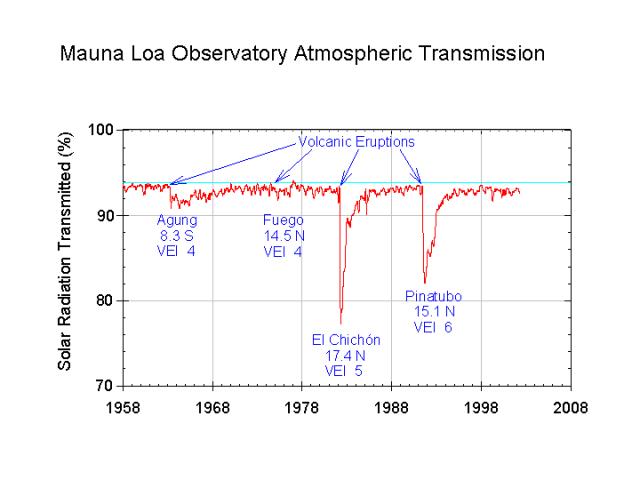
Pinatubo in 1991 reached over 110,000 feet and El Chichon 105,000 feet in 1982. Both Mt. St. Helens in 1980 and Cerro Hudson in 1991 reached around or just over 60,000 feet. Chaiten may fall into that category of a St Helens or Cerro Hudson and have some effect on the climate. the activity has not ceased and it is still possible a larger eruption will follow. The long lasting (5 days plus) nature of this eruption adds to the likelihood of an effect. It’s higher latitude means a a lower stratosphere and increases the chances of material being injected into that stable layer.

Note how much a major eruption can reduce incoming solar energy. This would add to the global cooling from the ocean flips and the a super long cycle 23 and possibly quiet solar cycle 24.
See larger graph here.
See larger graph here.
One other note, back over a decade ago, there was some speculation that volcanic activity led to El Nino development as the ash reduced the thermal and thus pressure gradients and through them the equatorial easterlies, reducing cold water upwelliing in the eastern Pacific and favoring the sloshing east of warm water from the western Pacific. Anecdotally the super El Nino of 1982/83 followed El Chichon and the El Ninos of 1991/92 and 1992/93 followed Pinatubo and Cerro Hudson. Stay tuned as better assessments are made of how much Chaiten may play a role on what’s ahead.
source
-->
-->
Saturday, May 3, 2008
Adding Carbon Dioxide To The Atmosphere May Be Beneficial, Says Roy Spencer
Here is another article by Dr. Roy Spencer. He reiterates his doubt about the myth of man-caused global warming. In addition he speculates on the reason why man's addition of carbon dioxide to the atmosphere may really be beneficial, instead of harmful, as so many people mistakenly believe. If he is is correct, then all of our efforts to limit CO2 emissions are a terrible, tragic waste of effort and resources.
Of course Dr. Spencer is not the first person to come to this conclusion, but he is one of a growing number of scientists who have come to the same conclusion. Search the blog here for Roy Spencer and you will find much more of what he has to say on the weather, climate, and global warming. Also, please note he has a new book out titled "Climate Confusion: How Global Warming Hysteria Leads To Bad Science, Pandering Politicians, And Misguided Policies That Hurt The Poor".
Peter
More Carbon Dioxide, Please: Raising a Scientific Question.
By Roy Spencer in National Review Online
There seems to be an unwritten assumption among environmentalists - and among the media - that any influence humans have on nature is, by definition, bad. I even see it in scientific papers written by climate researchers. For instance, if we can measure some minute amount of a trace gas in the atmosphere at the South Pole, well removed from its human source, we are astonished at the far-reaching effects of mankind’s “pollution.”
But if nature was left undisturbed, would it be any happier and more peaceful? Would the carnivores stop eating those poor, defenseless herbivores, as well as each other? Would fish and other kinds of sea life stop infringing on the rights of others by feasting on them? Would there be no more droughts, hurricanes, floods, heat waves, tornadoes, or glaciers flowing toward the sea?
In the case of global warming, the alleged culprit - carbon dioxide - just happens to be necessary for life on Earth. How can Al Gore say with a straight face that we are treating the atmosphere like an “open sewer” by dumping carbon dioxide into it? Would he say the same thing if we were dumping more oxygen into the atmosphere? Or more nitrogen?
As a climate researcher, I am increasingly convinced that most of our recent global warming has been natural, not manmade. If true, this would mean that global temperatures can be expected to peak in the coming years (if they haven�t already), and global cooling will eventually ensue. Just for the sake of argument, let us assume that manmade global warming really is a false alarm. In that case, we would still need to ask: What are the other negative effects of pumping more CO2 into the atmosphere? Read what they are and why they may not be problems
here.
-->
Monday, April 21, 2008
Why Scientists Are Skeptical
He, who has learned to doubt and to ask questions where the
norms forbid it, can never stop the habit. As such, every creative
person is building bridges to those masses of people who are tied
up helplessly by the pressures of peers and society. His is a step
out and above the group. And however strong the creative person
is enchained by conventions, he has unshackled himself on his
way as a free and autonomous personality. As such, he may
have cleared a new path for his group, his society and
perhaps humankind in order to transform culture and
to create space for other free personalities who want to
set new goals.
--Franz Oppenheimer (1864-1943)
Monday, April 14, 2008
Global Warming: A Technical Guide For The Layperson, By DocNavy
Global Warming: A Technical Guide For The Layperson, by DocNavy
Here is Doc's compilation of articles and information sources about global warming and climate change. In summary form this provides an excellent starting point for anyone wanting to learn more about the subject. Thanks Doc. Also, for anyone caring to get in on the debate over the causes of global warming and climate change, see here and here.
Peter
DocNavyMessage #1 - 09/20/07 02:17 PMGreetings! Here for your perusal are a number of articles, and websites that explain Global Warming. As it is a complex subject that is EASILY spun in many directions, I have tried to pull together a few resources that help explain it in easy terms. All of these sites contain referenced material, if you wish to go more in depth.If anyone has more information that they'd like to include, please post it. Please make sure that your posts contain active links, and the material can be understood by anyone.
Doc
*Disclaimer* A number of sites I list could be classified as "Skeptic", but even those sites endeavor to show accurate scientific data. The terms "AGW" and "GW" Stand for "Anthropogenic Global Warming", and ""Global Warming" respectively.
*NEW!* What does John Coleman, FOUNDER of The Weather Channel, think of AGW? HERE (Thanks GeoPete)
*NEW!* An interview with REID BRYSON, one of modern climatology's founding scientists about what he thinks of AGW, HERE.
*NEW!* Senator Inhofe's paper (Including speeches) on Global Warming. Previously ONLY AVAILABLE to policymakers, and Media Heads, HERE.
*Revised* A decent referenced primer that covers most everything related to AGW, HERE.
An easily read investigative article on the foundations and history of AGW, HERE.
*NEW!* Are CO2 Levels HIGHER than they have ever been? Is the Earth moving into an
UNPRECEDENTED high in Global Temperature? Find out, HERE.
A somewhat brash, though still good article on what might be causing GW, HERE.
An engaging academic DEBATE between Pro-AGW authorities and "Skeptics".
*UPDATED* A transcript of "An Inconvenient Truth" and a LINK to the Video, accompanied by a LINK (Pt.1), LINK (Pt.2) to Pacific Research Institute's documentary about AIT's presentation of scientific "Facts".
*NEW!* Lord Monckton's paper outlining 35 "Inconsistencies" of AIT, HERE.
LINK to "The great Global Warming Swindle" Documentary that is a response to "An Inconvenient Truth."An interesting article on the historical Climate Change Crises claims,
HERE.An interactive explanation of what "The Greenhouse Effect" is, HERE.
An explanation of what "Carbon Sequestering" or a "Carbon Sink" is, HERE.
The "Hockey Stick", a peer reviewed paper on exactly what it is, HERE.
A peer reviewed paper on the science of Climate Change, HERE.
*Revised* A referenced article explaining some of the more esoteric and confusing mathematical expressions often cited in IPCC TAR Report used to express actual warming, HERE.
Transcript of the Testimony of Richard S. Lindzen before the Senate Commerce Committee on 1 May 2001 on Global Warming and The Kyoto Protocol.
A peer reviewed paper explaining Climate Change, The Kyoto Protocol, it's results and how it effects the World, HERE.
A peer reviewed paper discussing the effect of a warmer, CO2 enhanced World on Human Health, HERE.
--==One of my personal FAVORITE reads!!==--*NEW!* A companion paper to the one above, submitted in the Journal of American Physicians & Surgeons. Now you know what the Doctors know. HERE. Dated FALL 2007.
*NEW!* An outstanding and easily understood article on Water Vapor and it's relationship to the Greenhouse Effect, HERE. (Thanks DietDew)
An article from the WASHINGTON POST about the "Fuzzy Math" used by mainstream media about Climate Change, HERE.
An excellent site explaining what thermal inversions, and Photochemical Smog are, HERE. (Thanks LtDan)
A DEVASTATING documentary on the attitudes and motivations behind the modern
Eco/Enviro movement, and the disparity between what is seen in the media and what is done in real life, HERE.
*NEW!* The OFFICIAL report from the US Senate Committee on Environment & Public Works about what is really happening to Alaskan Polar Bears, HERE.
*NEW!* IS THERE A SCIENTIFIC "CONSENSUS" on Global Warming?? The OFFICIAL report from the US Senate Committee on Environment and Public Works dated 20 DECEMBER 2007, HERE. (**Updated 22 FEB 08**)
**UPDATED!!** 07APR08
Wednesday, April 9, 2008
Climate Fearmongering And The Danger To Democracy
This comment clearly explains why we must seek and demand that the truth about the causes of global warming and climate change be found and related to everyone who cares.
Peter
THE BBC, CLIMATE HYSTERIA AND THE CRISIS OF DEMOCRACY
An email from John A [johna.sci@googlemail.com] of Climate Audit
Can it be any more apparent that the BBC is actively engaged in laundering environmental reports especially on climate to satisfy a few extremists? That what we read about climate history changes faster and more efficiently than even Winston Smith could have managed with his Speakwrite?
Witness the constant changing of historical temperature data by James Hansen now being dissected on Climate Audit. This is not simply a scandal, it is a crisis reaching to the foundations of our democracy - that news and information be disseminated by a Free Press without fear or favour to the Powers that be, nor to extremists and radicals seeking the overthrow of democracy by stealth through a crisis which bears all the hallmarks of being manufactured?
Just imagine, for a moment, what a global emissions trading scheme would look like: no Western democracy would have any control over the price of energy even in its local markets, its entire economy being subject to minute bureaucratic control of everything from the gas heater in the house to energy required to produce steel. Without any control of the cost of energy, food prices would inevitably rise and a black market in basic foodstuffs would appear (this is what happened during the fall of the Soviet Union) including a resurgent Mafia-style criminal underclass.
What then, would be the point of voting for any party? Or of democracy itself? What state could withstand the inevitable social turmoil when basic foodstuffs become more expensive than the poor can afford because the market has been rigged?It is axiomatic that any State, no matter how brutal, must eventually fall when it has lost control of the price of food - witness Zimbabwe right now, or the fall of the Soviet Union, or the fall of Suharto in Indonesia, or the Weimar Republic in the early 1930s.Make no mistake, and speaking as a classical liberal, we are looking at the most serious attempt to collectivize the world economy since the fall of Communism in the 20th Century and to render democracy moot in the Western World and beyond.
Who speaks for the farmers of Kenya whose exports into the EU and beyond are the only thing between themselves and starvation and whose products are now being labelled with airmiles by Western environmental extremists?Did any of us vote for the imposition of world energy cartel? I can't remember such a proposition being on any manifesto. But that's what it is.All of this makes the betrayal of the BBC even to its own charter that much more dangerous to all of us who hold liberal democracy so dear.
In the "Green Room" we see academics and activists talk blandly about population control (really? how?), the marginalization of democracy through a consensus of self-appointed "experts" and the need to somehow control the absolutely uncontrollable (the Earth's climate) via trying to moderate a single variable, carbon dioxide concentration, whose ability to control climate in any meaningful way is entirely absent from any paleoclimatic proxy?Yet the opinions given by academics on subjects well away from their areas of specialization are published as if those opinions are unquestionable truths. Comments are censored prior to publication to prevent serious criticisms being made, and a false impression of support for the ludicrous and dangerous propositions is thereby created.No right of reply is ever allowed except by that favourite abuse of propagandists - the "skeptic sandwich". Note that twice now, the BBC has announced that the work of Svensmark has been debunked, and twice Svensmark has replied showing that the studies are flawed and the BBC has refused to publish those replies.
Friday, April 4, 2008
The Real Effects of Carbon Dioxide
The following is an important article about the effects of carbon dioxide on life on planet Earth. Please read it and save it for future reference.
Peter
http://friendsofscience.org/assets/files/documents/robinson.pdf
Peter
http://friendsofscience.org/assets/files/documents/robinson.pdf
Subscribe to:
Posts (Atom)